Squirrel Valley Observatory W34
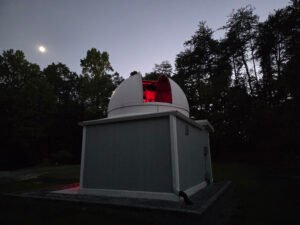
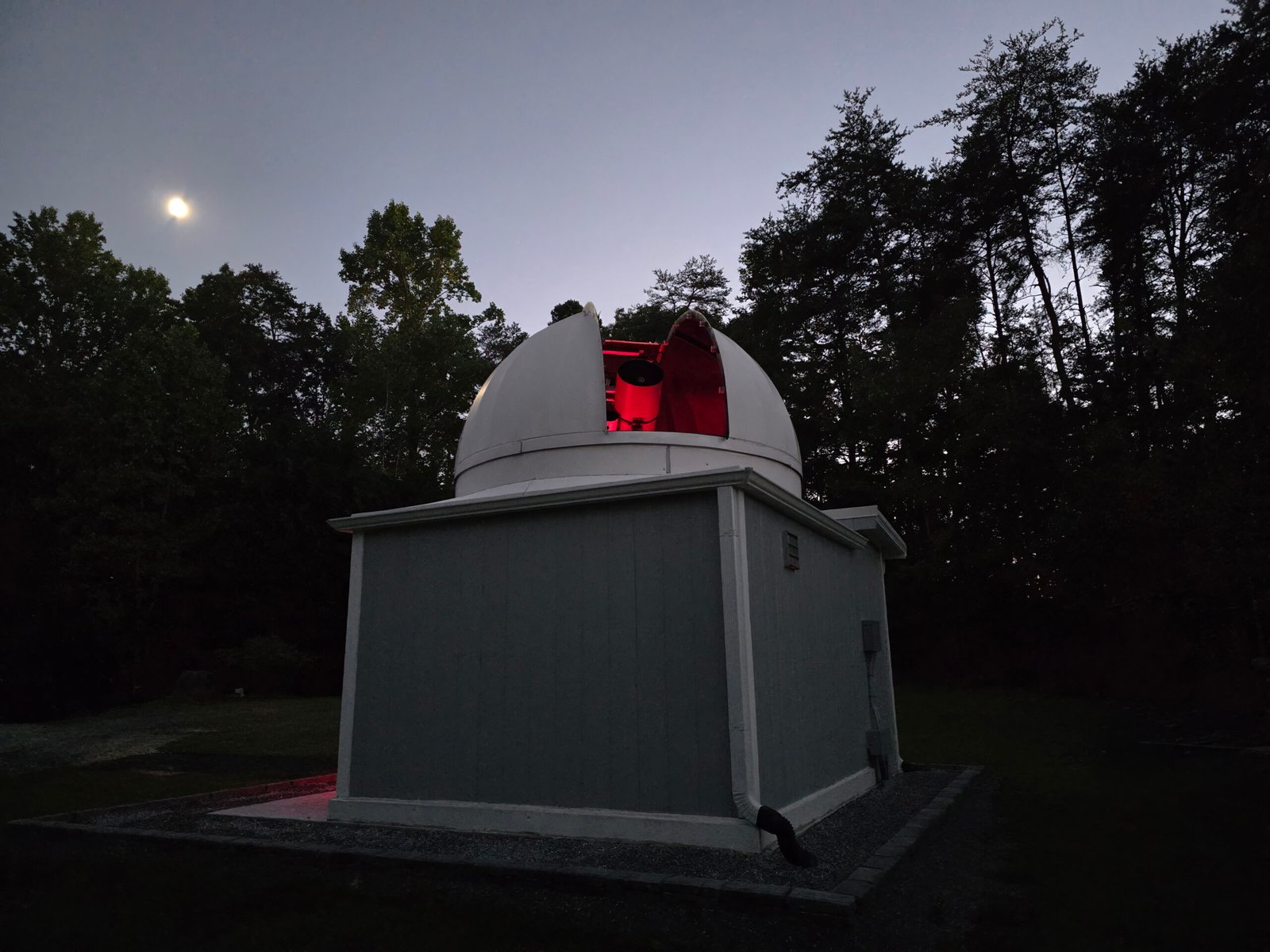
Squirrel Valley Observatory MPC-W34 is a privately owned observatory located in the foothills of western North Carolina. Major construction of the roll off roof observatory was completed in the summer of 2015 with equipment upgrades continuing to be made for private research and astrophotography. The observatory is the culmination of a life long dream. In September of 2016 the IAU Minor Planet Center assigned the observatory code, W34, to Squirrel Valley Observatory for it’s endeavors in the tracking and detection of minor planets, including hazardous asteroids and other Near Earth Objects. In 2019 we were awarded the Planetary Society’s 2019 Shoemaker NEO Grant for our work in near earth asteroid studies. In 2025 construction began on a new domed observatory on the property. Initial calibration and testing commenced in January 2026.
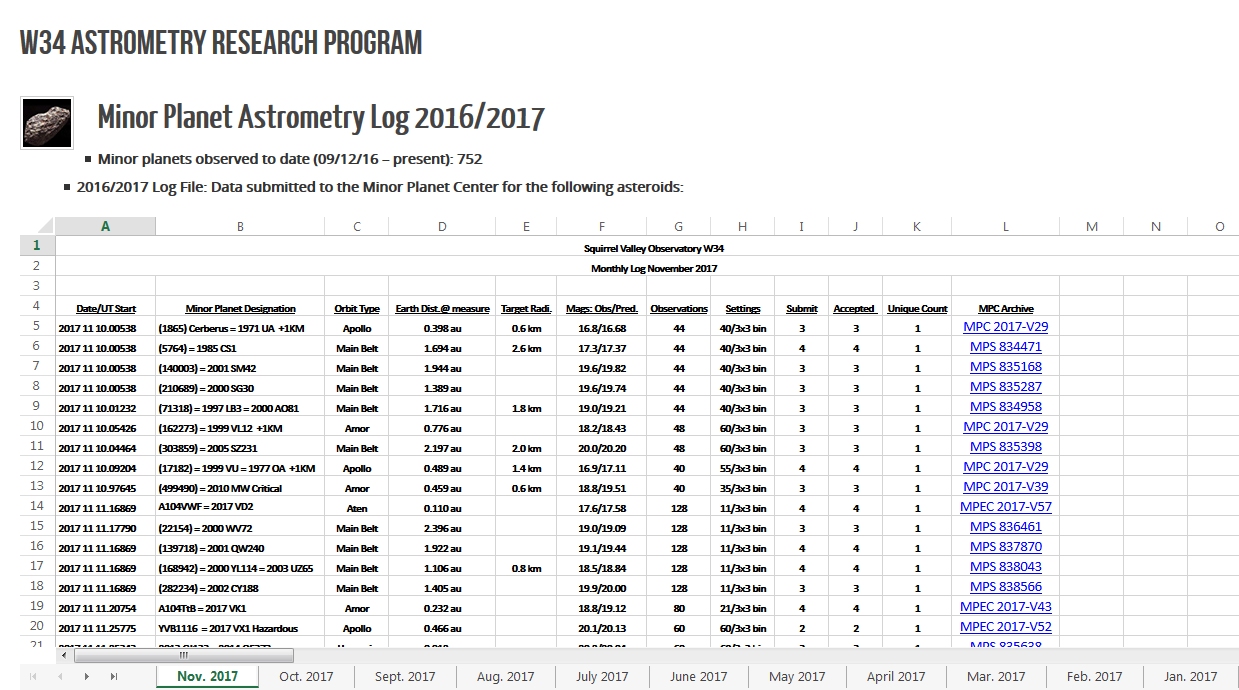
The primary mission of the observatory has been astrometric research (the detection, confirmation and tracking of minor planets, ie hazardous asteroids, near earth objects, comets, and other various types of asteroids) and astrophotography work. The observatory sends astrometric data to the International Astronomical Union’s Minor Planet Center on a regular basis, where is it used to help refine orbit predictions of various minor planet bodies. Each month the results are published in the minor planet circular. Additional research such as generating light curves for some of the larger exoplanets has also been carried out. With the new domed observatory coming online, it is expected that the primary mission will expand to encompass additional areas of astronomy and research. Our default configuration is an imaging setup used for asteroid astrometry or astrophotography. It is anticipated that minor planet astrometry, supernova detection and exoplanet research will continue to be the primary types of research conducted for the foreseeable future. Today even small facilities such as this are able to make important contributions to astronomical research.
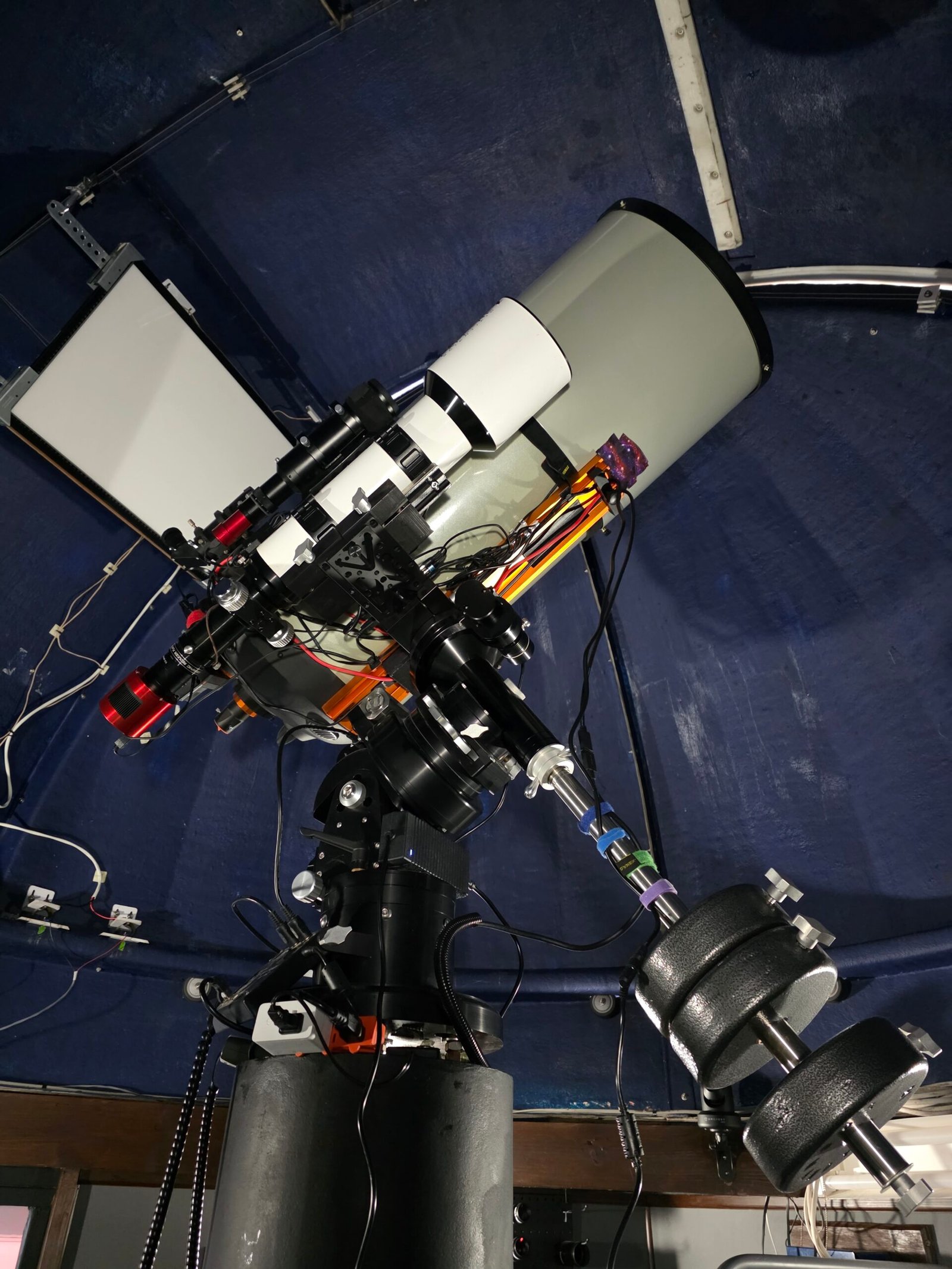
The domed observatory currently utilizes a Celestron EdgeHD 14″ as our primary scope (aplanatic schmidt-cassegrain), which tracks the sky via a Losmandy G11GT/Gemini 2 system mount. The mount is in turn secured to a 12″ steel pier, bolted to an isolated concrete pier/footer. This setup minimizes vibrations that are detrimental to long exposure imaging. An auto-guider system is also used to provide for even longer exposures. An Explore Scientific 102mm triplet refractor also rides on a “side saddle” next to the Celestron 14. The original roll off roof observatory will soon house a stored Explore Scientific CF 127mm triplet refractor on a Losmandy G11/Gemini 2 mount. A Celestron EdgeHD 8″ (aplanatic schmidt-cassegrain) and AVX mount is also available for portable field use. The primary and secondary scope can be computer controlled from the observatory warm rooms and and from inside my home.
For the first 3 years of operation the primary optical telescopes were rather modest in size, (a Celestron EdgeHD8 an Explore Scientific CF 127mm triplet refractor and an Explore Scientific 102mm triplet refractor). The addition of sensitive imaging cameras enabled them to detect, track and image very faint objects. In 2019 the observatory was upgraded to a larger Celestron EdgeHD14 with a heavier duty Losmandy G11GT mount. The upgrade of the 14″ Aplanatic Schmidt Cassegrain was graciously made possible by the CEO of Celestron Corey Lee.

Squirrel Valley Observatory Roll Off Roof Aerial View
Additional portable telescopes are stored in the observatory. They include a homemade 10″ f5.6 reflecting telescope which is currently in a dobsonian mount configuration (grab and point). It is awaiting some upgrades and much needed maintenance. The remaining instrument is a small, highly portable Meade ETX 80mm short tube refractor on a Meade goto mount. This is used as a grab and go scope for the brightest of objects and is not intended for serious imaging or research. There is also a Celestron 3″ “FirstScope tabletop reflector available for hands on public educational purposes.
The facility also houses a small real time weather station which is available online 24/7.
The observatory is funded primarily by the owner.
Director/Operator/Janitor: Randy L. Flynn
Facility Support Technician: Steve Saft